
 | ||||
Study Skills, Tips & Strategies
for College Students
from Science Prof Online
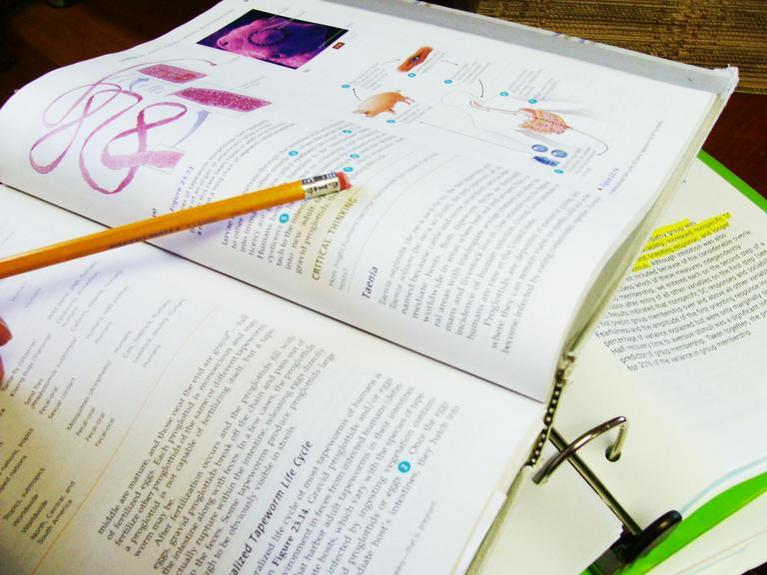
As a college instructor who teaches introductory-level classes, I see many students – those straight from high school as well as returning, non-traditional undergrads – struggle with the college-level work load. The following are easy-to-follow, basic strategies that can help new students succeed.
Show Up for Class
This might sound obvious, but students who do not regularly attend class do
Article Summary: Many new college students find themselves unpleasantly surprised by the quantity and quality of work expected. Here are some tips for academic success.
How to Study for College Courses
Nope. You can't absorb information through the side of your sleeping head.

You have free access to a large collection of materials used in a college-level introductory Cell Biology Course. The Virtual Cell Biology Classroom provides a wide range of free educational resources including Power Point Lectures, Study Guides, Review Questions and Practice Test Questions.

You have free access to a large collection of materials used in a college-level introductory microbiology course. The Virtual Microbiology Classroom provides a wide range of free educational resources including PowerPoint Lectures, Study Guides, Review Questions and Practice Test Questions.

Page last updated: 1/2015


SPO VIRTUAL CLASSROOMS
| ||||||

not regularly pass. Plan to attend every single class meeting. If you are unable to attend, make arrangements to quickly catch up on the material covered during your absence.
Find a “Notes Buddy”
At one of the first class meetings, make an effort to get contact information from at least one of your classmates (preferably from a few classmates), so that if you need to miss class, you will be able to contact your notes buddy to get a copy of the information that you missed. You can return the favor when and if your notes buddy misses class.
Unless you instructor invites you to contact him or her for missed material, do not ask your instructor to help you get caught up from your absence. Getting your hands on missed material is your responsibility. And never, ever ask your instructor, “Did I miss anything?” Assume that you did miss something, and find out what you need to make up through your own efforts.
How Much Time Should Be Spent on Coursework Outside of Class?
The rule of thumb for the amount of time that should be invested in homework and studying is AT LEAST 2 to 1 – at minimum, spend two hours outside of class working on course material for every one hour that you spend in class. This is an important rule. I find that students who put the time and effort into my classes, even if they struggle with the material, rarely fail.
Tips for Studying for a College Course
There are many different strategies that students can use to study successfully. Having a “Study Buddy” or a “Study Group” can be very useful. A meeting-of-the-minds can help correct misunderstanding of material and create memories that allow the participants to better retain information. Also, teaching is one of the best ways to learn. So when one student helps another understand a difficult concept, the student doing the “teaching” benefits as well.
If your class has a textbook as well as notes created from lecture, it can be helpful to, after each class, use the book and notes together to create portable notes on large or small index cards. Index card notes can be hole-punched, put on a key ring, and carried with you. Brief, frequent study efforts are much more effective than hours of cramming the night before an exam. It’s kind of like "The Tortoise and The Hare" fable -– slow and steady studying wins the grade.
See if Your School Offers Free Tutoring
Many colleges have a Tutoring Center or Learning Center that provides tutors for a wide range of subjects at no additional cost to enrolled students. Check with your college or university to see if they offer this service. A tutoring program can be immensely valuable, particularly for students who are putting in the effort, but still having difficulty mastering the material.
The following are websites that offer more useful information for college success:
- Study Skills Workshop #1: Habits of Successful College Students
- Science Prof Online free science education website
- Tutor Hunt: Website that connects tutors and students seeking academic help, free.
