Man Yawning, Painting by Joseph Decreux


Fixed Action Patterns: 
Instinctive Behavior of FAPS

from Science Prof Online

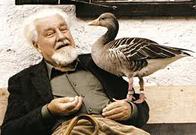
Konrad Lorenz, Pioneering Ethologist, Holding Graylag Goose
CELL BIOLOGYMICROBIOLOGYPOWER POINTS

VIRTUAL CLASSROOMS


Science Prof Online (SPO) is a FREE science education website. Donations are key in helping us continue to provide this FREE resource. 
Please help!

(This donation link uses PayPal on a secure connection.)

Article Summary: A fixed action pattern (FAP) is an instinctive behavioral response triggered by a very specific stimulus. Once triggered, the FAP behavior can’t be stopped ‘midstream’, but must play out to completion. Yawning is one example. 
FAPs are produced by a neural network known as the innate releasing mechanism. The FAP is triggered in response to an external sensory stimulus known in animal behavior terms as a sign stimulus, or, if it is a signal from one individual to another, it is called a releaser.

Egg Rolling and the Greylag Goose
Niko Tinbergen, a pioneering researcher of animal behavior, studied the egg rolling behavior of the Greylag Goose as an example of an FAP. If one of the gooses' egg rolls away from the nest, the goose automatically rolls the egg back to the nest with a repeated, specific action. When the female notices an egg outside the nest (sign stimulus), she begins this repeated movement to drag the egg with her beak and neck.

If, while the goose is rolling the egg back to the nest, the egg slides off to the side, or is removed by an observer, the goose continues to repeat the stereotypic movements, until she reaches the nest. She'll then relocate the missing egg and begin the process all over again.

Avian Mating Dances
Mating dances are another FAP example. Many varieties of birds engage in this type of courtship behavior, which often consists of a specific sequence of elaborate movements. Sometimes both birds perform the dance together, but in many cases, it is an ornately feathered male dancing for the female.In this case, the key stimulus for this FAP is the presence of the female, and she chooses her mate based on how elaborate his plumage and how well he can boogie down.

Red-Bellied Stickleback Aggression
Niko Tinbergen also studied a species of fish commonly called the red-bellied stickleback. The male of this species turns bright red and blue during breeding season, a time during which they are naturally aggressive towards other red-bellied sticklebacks. The bright blue and red coloring of other male competitors (or sometimes anything that is bright blue and red) triggers aggression.

This behavior is useful because the stickleback needs to secure an area to use for obtaining food and mating with females. The color-induced aggression helps keep interlopers out.

The FAP of Yawning
Although fixed action patterns are most common in animals with simpler cognitive capabilities, humans also demonstrate fixed action patterns. Yawning is a great example. Yawns last around 6 seconds and are difficult to stop once started.

We are triggered to yawn when we see another person (or animal) yawning. Even seeing the word 'yawn' may have triggered some readers to do so. And just try stopping in mid-yawn. You can't. Once you begin to yawn, this instinctive, hard-wired response must run its course, from beginning to end.

Trickery and FAPs
Some species have evolved to take advantage of the fixed action patterns of other species by mimicking their sign stimulus. The term used to describe the duplication of another species' releasing mechanism is known as code-breaking.

Examples of Code Breaking
Brood parasitism gives us one example of code breaking. This form of parasitism is when one species lays its eggs in the nest of another species, tricking the owner of the nest into parenting young that are not its own. This happens in the case of the North American cowbird and the European cuckoo, both brood parasites.

Chicks of these parasitic species push the eggs and hatchlings of the nest owners out of the nest. Then, being larger and louder than true offspring of the parent species, the cowbird hatchling provides a supernormal feeding stimulus to its 'adoptive' parent, which will cause the parent to forage more frequently than it normally would, all to satisfy this larger, impostor baby's demands.

Source
  • Alcock, John (2005) Animal Behavior: An Evolutionary Approach. Sinauer Associates, Incorporated


This article originally appeared on Suite101 online magazine.​

Page last updated 4/2012
Fixed Action Patterns: Instinctive Behavior of FAPS
FAP of Gull Chick Pecking Red Spot on Partents Beak to Trigger Regurgitation by Brian Gratwicke
Kelp Gull chicks peck at red spot on mother's beak to stimulate regurgitating reflex.
Virtual Cell Biology
Classroom


You have free access to a large collection of materials used in a college-level introductory Cell Biology Course. The Virtual Cell Biology Classroom provides a wide range of free educational resources including Power Point Lectures, Study Guides, Review Questions and Practice Test Questions.
Endomembrane System of a Eukaryotic Cell, Mariana Ruiz
facebook link
SPO twitter
Tamislinked in page