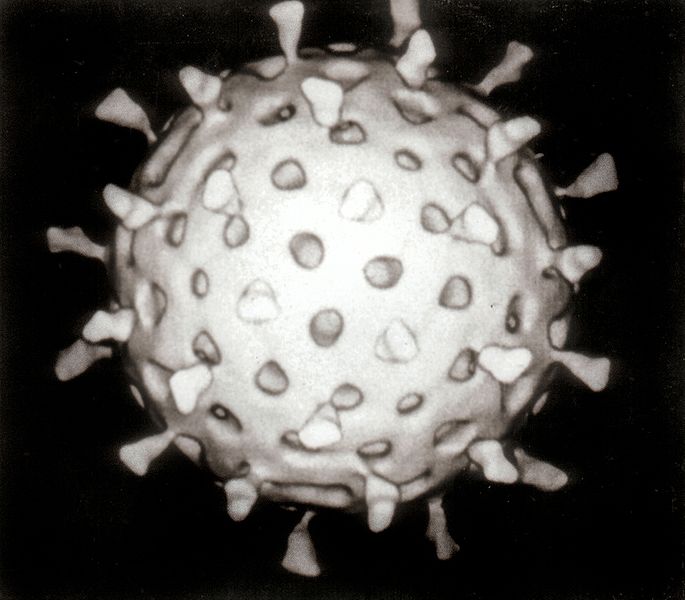
Computer assisted reconstruction of a rotavirus particle

What Is a Virus?

from Science Prof Online


Acellular Particles: Viruses
Although they may seem to behave as living things, viruses are actually acellular, nonliving particles. Viruses are not considered to be living organisms because they are incapable of carrying out all life processes. The factors that distinguish them as nonliving are as follows.

Viruses…
  •   are not made of cells
  •   can't reproduce on their  own
Article Summary: Viruses are not living cells, but efficient parasites that commandeer living cells and turn them into virus factories. Learn how these nonliving particles act so smart.
Virus 101: Structure, Classification & Reproduction
Virtual Microbiology
Classroom


You have free access to a large collection of materials used in a college-level introductory microbiology course. The Virtual Microbiology Classroom provides a wide range of free educational resources including PowerPoint Lectures, Study Guides, Review Questions and Practice Test Questions.
Prokaryotic Cell, Mariana Ruiz
Virtual Cell Biology
Classroom


You have free access to a large collection of materials used in a college-level introductory Cell Biology Course. The Virtual Cell Biology Classroom provides a wide range of free educational resources including Power Point Lectures, Study Guides, Review Questions and Practice Test Questions.
Endomembrane System of a Eukaryotic Cell, Mariana Ruiz
Intracellular and Extracellular Viral Form
Viruses exist in one of two states; extracellular and intracellular.
  • Extracellular State: Before it invades a host cell, a virus is in the ‘extracellular state’. An extracellular virus is called a virion (vie-ree-on). In this form, the virus consists of a protein coat (capsid) surrounding nucleic acid. In addition, some viruses have phospholipid envelope surrounding the capsid. This outermost layer provides protection and recognition sites for host cells.
  • Intracellular State: Once the virus invades a host cell it is in an ‘intracellular state.’ In this state, the capsid is removed and the virus exists as only as nucleic acid (genetic material).

Example of a Virus: The Common Cold
The common cold is caused by a family of viruses called Rhinoviruses. Cold virus spreads from infected persons through the air and land on your nose and throat when you breathe in infected air. From the throat, the Rhinovirus tricks your cells into making more of viruses which then fly out of you with the aerosol of a sneezes to infect those around you.

When your body ‘realizes’ that it is infected with a virus, inflammation occurs as your body tries to eliminate the virus. The fever and other miserable cold symptoms that you experience are created by your body as a response to the viral invasion.

Sources
  • Bauman, R. (2005) Microbiology. Pearson Benjamin Cummings.
  • Park Talaro, K. (2008) Foundations in Microbiology.

Animal Virus Cycle of Infection
​Page last updated: 5/2013
Portions of this article originally appeared on Suite101 online magazine.​
SCIENCE PHOTOS
CELL BIOLOGYMICRO BIO 8-WKMICRO BIO 16-WKINSTRUCTORS

facebook link
SPO twitter
Tamislinked in page
SPO VIRTUAL CLASSROOMS
Kids of All Ages Can Explore Science Together At Home Kids of All Ages Can Explore Science Together At Home
Kids of All Ages Can Explore Science Together At Home Kids of All Ages Can Explore Science Together At Home Kids of All Ages Can Explore Science Together At Home
Kids of All Ages Can Explore Science Together At Home Kids of All Ages Can Explore Science Together At Home Kids of All Ages Can Explore Science Together At Home Kids of All Ages Can Explore Science Together At Home
Kids of All Ages Can Explore Science Together At Home Kids of All Ages Can Explore Science Together At Home Kids of All Ages Can Explore Science Together At Home
Kids of All Ages Can Explore Science Together At Home Kids of All Ages Can Explore Science Together At Home
Kids of All Ages Can Explore Science Together At Home
Kids of All Ages Can Explore Science Together At Home Kids of All Ages Can Explore Science Together At Home
Bacteriophage Viruses Attacking a BacteriumBacteriophage Viruses Attacking a Bacterium
Bacteriophage Viruses Attacking a BacteriumBacteriophage Viruses Attacking a BacteriumBacteriophage Viruses Attacking a Bacterium
Bacteriophage Viruses Attacking a BacteriumBacteriophage Viruses Attacking a BacteriumBacteriophage Viruses Attacking a BacteriumBacteriophage Viruses Attacking a Bacterium
Bacteriophage Viruses Attacking a BacteriumBacteriophage Viruses Attacking a BacteriumBacteriophage Viruses Attacking a Bacterium
Bacteriophage Viruses Attacking a BacteriumBacteriophage Viruses Attacking a Bacterium
Bacteriophage Viruses Attacking a Bacterium
Bacteriophage Viruses Attacking a BacteriumBacteriophage Viruses Attacking a Bacterium
SPO is a FREE science education website. Donations are key in helping us provide this resource with fewer ads. 
Please help!

(This donation link uses PayPal on a secure connection.)

  •   do not grow or undergo division
  •   do not transform energy
  •   lack machinery for protein synthesis
  •   are so small that they can only be seen with an electron microscope

What Are Viruses Made Of?
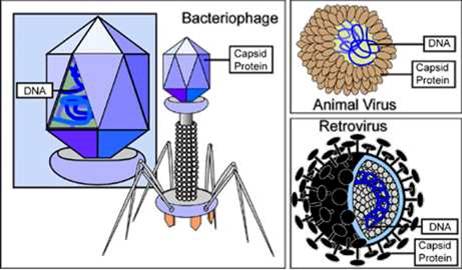
Viruses are composed of nucleic acidproteins and, in some cases, lipids as well. Nucleic acid, which can be either DNA or RNA, encodes the genetic information that is necessary to make copies of the virus.

The nucleic acid is surrounded by a protective protein coat, called a capsid. Some viruses are also surrounded by an outer membranous layer, called an envelope, made of lipid and protein.

Capsid Morphology
The viral capsid is a protein coat that provides protection for viral nucleic acid and is a means of attachment to host’s cells. It is composed of proteinaceous subunits called capsomeres. Some capsids are made of single type of capsomere while others include multiple types.

Viral Classification
There are several different ways that virologists (scientists who study viruses) categorize or classify these acellular particles.

Genetic Material: A virus can either have DNA (deoxyribonucleic acid) or RNA (ribonucleic acid) as its genetic material, but never both.

Capsid Structure: Viral capsids come in the following shapes:
  • Helical: When capsomeres are bonded together in a spiral shape
  • Polyhedral: Capsomeresform an essentially spherical shape comprised of small, flattened plates.
  • Complex: Any other different shape that is not polyhedral or helical.

Envelope: Viruses can be categorized based on the presence or absence of a membranous envelope surrounding the capsid.

Type of Cells They Attack: Different varieties of virus are very specific with respect to the type of cells that they invade.

Size of Virus: Although all are minute and only visible with the aid of a powerful electron microscope, viruses do come in a range of sizes. For example, the smallpox virus that attacks human cells is up to six times larger than the T4 bacteriophage virus that attacks bacterial cells.

How Do Viruses Reproduce?
Viruses reproduce via four basic steps. Viral reproduction includes:
  • Delivery of the viral genomes into a host cell
  • Commandeering of the host cell transcription and translation machinery
  • Use of the host cell’s building blocks to copy viral genomes and synthesize viral proteins
  • Viral genomes and proteins then self-assemble and exit host cells as new infectious particles.

Bacteriophage Viruses Attacking a Bacterium
Instructor's Corner