Bonding Structure of Peptidoglycan

Bacterial Cell Wall Structure 
Location and Amount of Peptidoglycan in 
Gram+ & Gram- Bacteria

Class Notes from Science Prof Online

CELL BIOLOGYMICROBIOLOGYPOWER POINTS

VIRTUAL CLASSROOMS


Science Prof Online (SPO) is a FREE science education website. Donations are key in helping us continue to provide this FREE resource. 
Please help!

(This donation link uses PayPal on a secure connection.)

Peptidoglycan (pep-tid-o-gly-can) is a molecule found only in bacterial cell walls  The rigid structure of peptidoglycan gives the bacterial cell shape, surrounds the plasma membrane and provides prokaryotes with protection from the environment.

Peptidoglycan is a huge polymer of interlocking chains composed of similar monomers. The backbone of the peptidoglycan molecule is composed of two derivatives of glucose: N-acetylglucosamine (NAG) and N-acetlymuramic acid (NAM). The NAG and NAM strands are connected by interpeptide bridges.

From the peptidoglycan inwards all bacterial cells are very similar. Going further out, the bacterial world divides into two major classes: Gram-positive (Gram +) and Gram-negative (Gram -).

Gram-positive Cells
In Gram-positive cells, peptidoglycan makes up as much as 90% of the thick, compact cell wall, which is the outermost structure of Gram + cells.

Article Summary: The amount and location of peptidoglycan in the prokaryotic cell wall is what determines whether a bacterium is Gram-positive or Gram-negative.
Bacterial Cell Wall Structure Class Notes
This article originally appeared on Suite101 online magazine.​

​Page last updated: 4/2012
Virtual Microbiology
Classroom


You have free access to a large collection of materials used in a college-level introductory microbiology course. The Virtual Microbiology Classroom provides a wide range of free educational resources including PowerPoint Lectures, Study Guides, Review Questions and Practice Test Questions.
Prokaryotic Cell, Mariana Ruiz
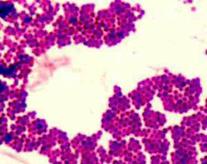
Gram-positive Staphylococcus. Thick peptidoglycan cell wall retains crystal violet primary Gram stain. 
Gram-negative Cells
The cell walls of Gram-negative bacteria are more chemically complex, thinner and less compact. Peptidoglycan makes up only 5 – 20% of the cell wall, and is not the outermost layer, but lies between the plasma membrane and an outer membrane.

This outer membrane is similar to the plasma membrane, but is less permeable and composed of lipopolysaccharides (LPS). LPS is a harmful substance classified as an endotoxin, The space between the cell wall and the plasma membrane is called the periplasm. Periplasm controls molecular traffic entering and leaving the cell.

Peptidoglycan and Antibiotics
Penicillins and cephalosporins interfere with the linking of the interpeptides of peptidoglycan, but because of the LPS membrane, these antimicrobials can’t access the peptidoglycan of gram-negative bacteria. Gram-positive bacteria, with no membrane outside the peptidoclycan cell wall, are more susceptible to these antibiotics.

Cell walls without intact peptidoglycan cross-links are structurally weak, and disintegrate when cells divide. This is how penicillins and cephalosporins work to disable bacteria.

Since the eukaryotic cells of humans do not have peptidoglycan cell walls, our cells are not damaged by antibiotics that target peptidoglycan, and microorganisms that do not contain peptidoglycan are also not susceptible to these drugs.

Sources
  • Bauman, R. (2005) Microbiology.
  • Park Talaro, K. (2008) Foundations in Microbiology.

Gram positive cell wall structure