
 | ||||
Metabolism: Aerobic Respiration
Main Page
from Science Prof Online
 | | |||||
| | | ||||
| | | | |||
| | | ||||
| | |||||
| ||||||
| | |||||

Aerobic Respiration Biology Lecture Materials
These
are the Aerobic Respiration Lecture materials of the Virtual Cell
Biology Classroom. The resources below are used to supplement an actual
college cell biology course.
You have free access to a large collection of materials used in a college-level introductory Cell Biology Course. The Virtual Cell Biology Classroom provides a wide range of free educational resources including Power Point Lectures, Study Guides, Review Questions and Practice Test Questions.


SPO VIRTUAL CLASSROOMS
LEARNING OBJECTIVES
These lecture learning objectives are a study guide based on the VCBC Aerobic Respiration Lecture PowerPoint:
- Understand difference between catabolism and anabolism, and what these reactions have to do with metabolism.
- Understand what a redox reaction is and what this type of reaction has to do with metabolism.
- What is ATP, and what is its significance in metabolism.
- What is phosphorylation?
- Understand the steps of aerobic cellular respiration, with respect to the four sub-pathways (glycolysis, synthesis of Acetyl-CoA, Kreb's Cycle & the electron transport chain). For each sub-pathway, what is the starting molecule, end product molecule, and what energy is extracted?
- What is oxygen's role in aerobic cellular respiration?
- Where does metabolic energy originate? How is it captured? What organelles and pigments are involved?
LECTURE POWERPOINT
Versions of Aerobic Respiration PPT:
- Student's Aerobic Respiration PowerPoint Show
- Student's Aerobic Respiration PowerPoint PDF Printout
Printing: The best way for students to print out the PowerPoint Show is to download the PDF version. Select Print, and, when the Print screen comes up, go to the Print Handling options. Under Page Scaling, select "Multiple pages per sheet", Under Pages per sheet, select "2". That uses up less paper, placing two slides on each page.
The Aerobic Respiration Lecture materials include:
- list of learning objectives
- PowerPoint lecture
- practice test & review questions
- term paper metabolism assignment
MORE AEROBIC RESPIRATION LINKS
- Cellular Respiration animation by Jay Phelan.
- How NAD+ Works animation and quiz from McGraw-Hill.
- Glycolysis animation and quiz from McGraw-Hill.
- Krebs Cycle Animation & Quiz 1 from McGraw-Hill.
- Krebs Cycle Animation & Quiz 2 from McGraw-Hill.
- Electron Transport Chain animation from Molecular & Cellular Biology Learning Cntr.
- Electron Transport Chain click through animation by Graham Kent Bio231 Cell Bio.
- Electron Transport System & Formation of ATP (Quiz 1) by McGraw-Hill.
- Electron Transport System & ATP Synthesis (Quiz 2) by McGraw-Hill.
- Electron Transport Chain animated video by NDSU Virtual Cell Animations Project.
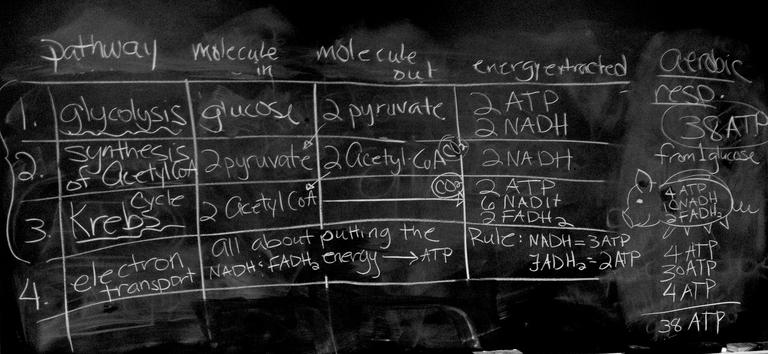
Table Summarizing the Four Subpathways of Aerobic Respiration
Click here for a blank printout of this table.
| ||||
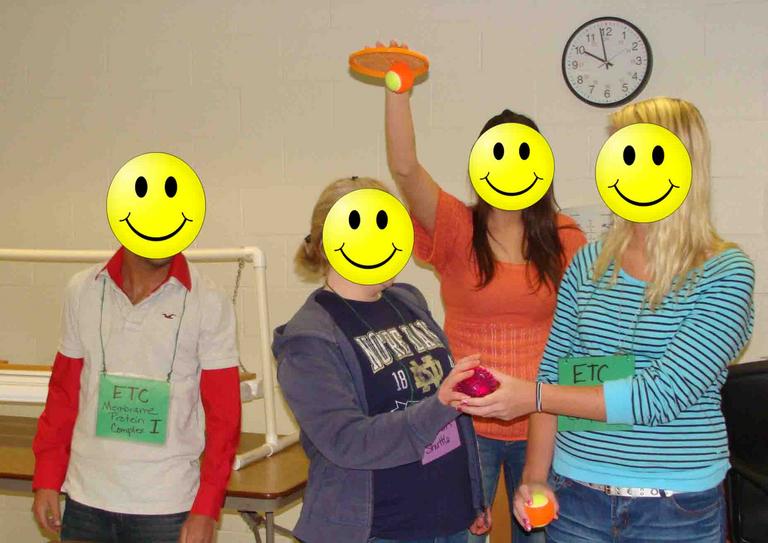
See the
for a fun, hands-on way to teach students the steps of the ETC!
Page last updated 10/2015
The SPO website is best viewed in Microsoft Explorer, Google Chrome or Apple Safari.

You have FREE access to a large collection of materials used in a college-level introductory biology course. The Virtual Biology Classroom provides a wide range of free educational resources including PowerPoint Lectures, Study Guides, Review Questions & Practice Test Questions.

AEROBIC RESPIRATION HOMEWORK
Word document of a single essay question given to students at the end of lecture. This tool helps the students review the main messages of the lecture while allowing the instructor to assess the classes' understanding of the material.
REQUIRED READINGS
Here is what students need to read, in addition to the PowerPoint, to master this topic.
- Why Do We Breathe? Aerobic Cellular Respiration
These multiple-choice / matching practice test questions and essay review questions are designed to help you better understand the material from this lecture.
METABOLISM PROJECT ASSIGNMENT
Word document instructions for writing a paper on the relationship between metabolism and nutrition. Allows students to choose one of three options. The Calorie King website has a food database to help you with finding grams of carbohydrates, fiber, protein & fats of common food items, for Option 1 of this project.
Classroom-tested Biology Homework Assignments
FREE from
ScienceProfOnline.com
