| ||||

Microbial Metabolism
Practice Test Questions
Virtual Microbiology Classroom of Science Prof Online

Free review questions to help students practice their understanding of this topic.

Microbial Metabolism Test Questions
SPO VIRTUAL CLASSROOMS
| ||||||
2. The formation of ATP from ADP would be considered...
a. catabolism b. anabolism c. cannibalism
d. decomposition
3. Where does electron transport of cellular respiration happen within the cell of a bacterium?
a. plasma membrane
b. cytoplasm
c. nucleus
d. mitochondria
e. chloroplast
4. Glycolysis is the breakdown of what?
5. Which parts of aerobic cellular respiration generate the carbon dioxide that we breathe out?
a. glycolysis & synthesis of acetyl CoA
b. synthesis of acetyl CoA & Kreb's cycle
c. Kreb's cycle & electron transport
d. glycolysis & electron transport
e. synthesis of acetyl CoA & electron transport
6. Anaerobic respiration differs from aerobic respiration in that...
a. in anaerobic respiration oxygen is not the final electron acceptor at the end of the electron transport chain.
b. anaerobic respiration can only produce 2 ATP.
c. anaerobic respiration only includes the metabolic pathway of glycolysis.
d. anaerobic respiration is an anabolic reaction type.
1. If yeast, sugar and water are mixed together, the yeast will metabolize the sugar using the process of fermentation. If this process takes place in a sealed container, the bubbles produced during fermentation will be trapped. What substance are these bubbles made of?
a. oxygen
b. methane
c. carbon
dioxide
d. lactic acid
e. ethanol
The following questions, from the Virtual Microbiology Classrooms (8-week & 16-week), are designed to help students better understand this topic. All questions are based on material that can be found on the Microbial Metabolism Lecture Main Page.
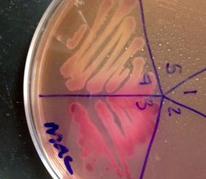
MacConkey's Agar with lactose negative Salmonella on top (colorless) and Lac + E. coli on bottom (hot pink).
Virtual Microbiology Classroom provides a wide range of free educational resources including PowerPoint Lectures, Study Guides, Review Questions and Practice Test Questions.

Page last updated: 2/2016



SCIENCE VIDEOS
How to Interpret Mannitol Salt Agar (MSA) Specialized
Bacterial Growth Medium
How to Interpret MacConkey's Agar (MAC) Specialized
Bacterial Growth Medium
7. Molecular oxygen is vital to the process of cellular respiration. It allows aerobic organisms to derive a great deal more energy from glucose than anaerobic organisms are able to. What is the vital role that oxygen plays in cellular respiration?
a. It is a reactant in glycolysis, necessary for the breakdown of glucose into pyruvic acid.
b. O2 is a waste product of Kreb's cycle.
c. O2 is required to build the acetyl-co-A molecule.
d. O2 is the final electron acceptor in the electron transport chain.
8. Anabolic reactions are when:
a. smaller molecules result from the breakdown of larger molecules
b. larger molecules are synthesized from smaller molecules
c. one molecule transfers a monomer to another
d. people eat each other
9. In an oxidation-reduction reaction, if a substance is oxidized it...
a. gains oxygen b. gains protons c. gains electrons
d. loses electrons
10. The differential aspect of MacConkey's agar (MAC) reveals what about the metabolic capabilities of the organism that grows there?
a. whether the bacteria is Gram + or Gram -
b. if the organism ferments mannitol
c. if the organism ferments lactose
d. if the organism produces hemolytic enzymes that can lyse erythroctes
e. if the organism is acid-fast
For more metabolism sample test questions see the Aerobic Respiration Practice Test Questions Part I and Part II and the Anaerobic Respiration Practice Test Questions.